
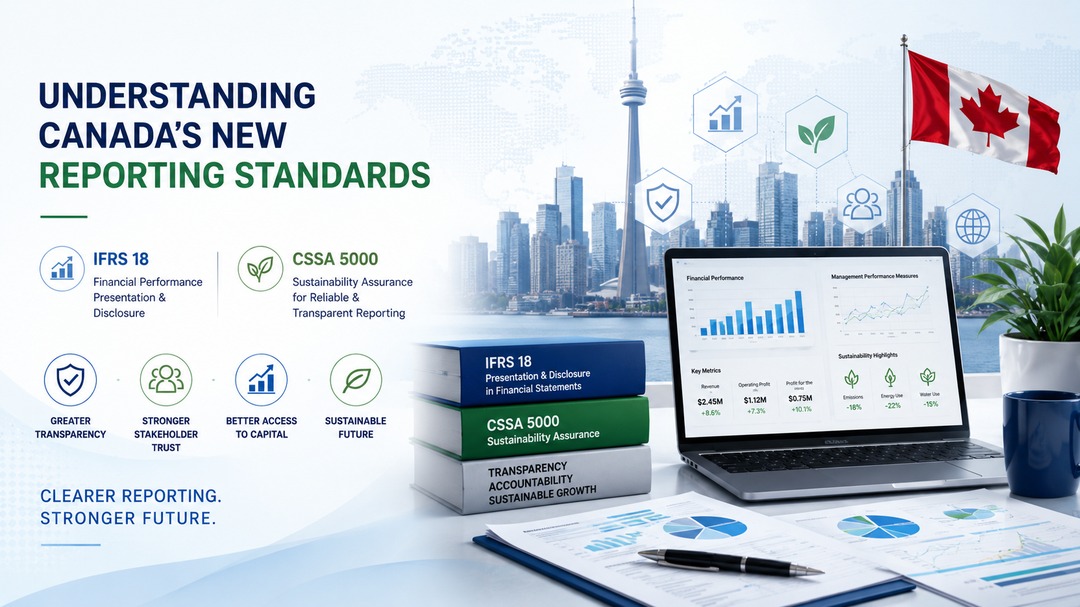
Understanding Canada’s New Reporting Standards
IFRS 18 and Sustainability Assurance (CSSA 5000)
Mid-2026 is a practical turning point for Canadian finance teams—not because everything becomes mandatory overnight, but because two major frameworks are now final, increasingly referenced by stakeholders, and approaching effective dates.
- IFRS 18 (issued by the IASB) changes how IFRS reporters present performance in the income statement and disclose management-defined measures. It is effective for annual periods beginning on/after January 1, 2027 (early adoption permitted).
- CSSA 5000 (Canada’s Sustainability Assurance standard) builds on the global baseline ISSA 5000. It supports independent assurance of sustainability information, ensuring that reported metrics are credible and decision-useful.
For entrepreneurs and corporations, these changes are not just technical. They can influence banking conversations, investor confidence, valuation discussions, governance expectations, and compliance readiness.
1) What is IFRS 18 and who does it affect?
IFRS 18 – Presentation and Disclosure in Financial Statements is a new IFRS Accounting Standard that updates how companies present financial performance—especially the statement of profit or loss (income statement) and certain disclosures. It aims to improve comparability by standardizing key subtotals and clarifying how items should be grouped and explained.
Who is impacted in Canada?
- Public companies and other entities that report under IFRS Accounting Standards will be directly affected.
- Private companies using ASPE are not automatically required to adopt IFRS 18—but may feel indirect pressure if lenders or investors expect IFRS-style reporting.
- Groups with subsidiaries, foreign investors, or financing covenants often need to plan early because presentation changes can affect reported subtotals and performance narratives.
Key IFRS 18 changes in plain language
- A more structured income statement
- IFRS 18 introduces clearer categories and required subtotals to help users understand operating performance versus other components of profit or loss.
- More discipline around management performance measures (MPMs)
- If management uses non-IFRS metrics (for example, “adjusted EBITDA” or “normalized earnings”), IFRS 18 requires clearer disclosure and reconciliation so users can understand what’s included/excluded and why.
- Better guidance on aggregation and disaggregation
- IFRS 18 encourages reporting that is neither too vague nor too cluttered—improving transparency in both line items and notes.
Timing
IFRS 18 is effective for annual reporting periods beginning on or after January 1, 2027, with early adoption permitted. June 2026 matters because it is the window to test reporting changes, validate comparatives, and align internal reporting before mandatory application.
2) Sustainability Assurance in Canada: CSSA 5000
As sustainability reporting expands (including GHG emissions, climate risks, social metrics, and governance practices), stakeholders increasingly ask: “Can we trust the numbers?” Assurance addresses that question by providing an independent conclusion over sustainability information.
CSSA 5000 (Canadian Standard on Sustainability Assurance) is Canada’s sustainability assurance standard aligned with the international baseline ISSA 5000. It sets overarching requirements for how assurance practitioners plan, perform, and report on sustainability assurance engagements across different frameworks and topics.
Why assurance standards matter—even for private businesses
Even if you are not publicly listed, sustainability data is increasingly used in:
- Financing (banks and private lenders)
- Procurement (government and large corporate vendor programs)
- Insurance underwriting and risk assessment
- Major customer due diligence and supplier screening
- Investor communications and stakeholder reporting
When does it take effect?
Canada’s CSSA 5000 implementation follows the global baseline, ISSA 5000, and is expected to be applied to sustainability assurance engagements in line with the standard’s effective-date guidance. For many organizations, the right way to interpret the timeline is simple: if you plan to publish sustainability metrics and expect third-party assurance, start building systems, controls, and documentation well in advance.
3) Why this matters for entrepreneurs and growing companies
Clearer financial statements can improve access to funding
Lenders and investors care about consistent performance reporting. IFRS 18 can change presentation and subtotals, which may influence covenant conversations or performance narratives—even if cash flows are unchanged. Early preparation reduces surprises.
Verified sustainability reporting strengthens credibility.
Sustainability claims without strong support can create reputational risk. Assurance performed under a recognized standard helps demonstrate that disclosures are reliable and decision-useful.
Compliance and governance readiness reduce risk.
Even when not strictly mandatory, these frameworks shape market expectations. Being prepared reduces the risk of rushed reporting, inconsistent metrics, and stakeholder distrust.
4) Practical action plan for June 2026
Treat mid-2026 as a readiness checkpoint. A practical approach:
If you report under IFRS (or plan to)
- Inventory your key performance measures (especially non-IFRS metrics such as adjusted EBITDA).
- Map current income statement line items to IFRS 18 categories/subtotals and identify presentation changes.
- Test comparatives and identify data gaps early (IFRS 18 is applied retrospectively, so comparatives matter).
- Align internal reporting packages so management reporting does not contradict external reporting.
If you publish (or plan to publish) sustainability information
- Define what you report and why (choose metrics that are decision-useful for your stakeholders).
- Strengthen data ownership (who produces it, who reviews it, and where it is stored).
- Build evidence files (methodologies, calculations, source documents, and assumptions).
- Decide whether you want limited vs. reasonable assurance and set a realistic timeline (many organizations start with limited assurance).
Conclusion
June 2026 is less about a sudden compliance cliff and more about getting ahead of the curve. IFRS 18 becomes mandatory for IFRS reporters starting in 2027, and Canada’s sustainability assurance framework is now established and converging with global practice. For Canadian businesses, the opportunity is straightforward: better reporting builds trust. Organizations that prepare early can improve transparency, strengthen lender and investor confidence, and position themselves as credible, future-ready operators.
Source: CRA
Newsletters
Love Is in the Numbers ❤️ February Update from RGB Accounting
NewslettersEvents & SponsorshipArticles & Publications
Start 2026 with Confidence — RGB Accounting Expands Across Canada.
NewslettersEvents & SponsorshipArticles & Publications
Closing the Year with Purpose: RGB’s 2025 Journey
NewslettersEvents & SponsorshipArticles & Publications
Growth with Purpose — Remembering Our Roots, Reaching New Markets
NewslettersEvents & SponsorshipArticles & Publications
October at RGB Accounting: Gratitude, Growth & Smart Financial Moves 🍁
NewslettersEvents & SponsorshipArticles & Publications
Events & Sponsorship
Toronto Entrepreneurs Conference @ Mississauga
May 08, 2019 Our B.E.S.T. (Business Entrepreneurs Services Team) Group has participated in this event for first time. Toronto Entrepreneurs Conference and Trade Show is the largest Entrepreneurs event in Canada. The event which targets business owners, partners or...
Hispanic Fiesta 2018
September 04, 2018 RGB Accounting will participate in this event for a second year in a row. Hispanic Fiesta will be held at Mel Lastman Square in Toronto during the Labour Day Weekend, August 31st, Sept. 1, 2, & 3, 2018. Hispanic Fiesta is a four-day celebration...
Secure Your Future Seminar 2018
June 20, 2018 This event gathered business owners running a small or medium-sized business, self-employed and incorporated businesses willing to learn tax saving strategies to help them utilize their company assets to secure their retirement. We are proud of having...
2nd Latino Business Expo Show
May 19, 2018 The 2nd Latino Business Expo Show held on May 19th at Daniels Spectrum gathered a wide range of entrepreneurs and business owners avid to learn how to take their businesses to the next level. RGB Accounting participated as vendor and speaker at this...
Hispanic Fiesta 2017
September 04, 2017 Hispanic Fiesta, a celebration of Spanish and Latin-American: Arts, Food, Music and Entertainment, is a four-day celebration filled with the splendid sounds, tempting treats and colorful culture featuring 300 local, national and International...
Articles & Publications
Changing Your Payroll Provider: A Small-Business Transition Guide and Checklist
Changing Your Payroll Provider: A Small-Business Transition Guide and Checklist By Roberto Belingueres, Founder & CEO, RGB Accounting Estimated reading time: 14 minutes Introduction: Why a Payroll Change Can Become a Compliance Problem Changing or cancelling a...
AI for Canadian Small Businesses: How to move faster without losing financial control
AI for Canadian small businesses: How to move faster without losing financial control A Canadian small business can adopt artificial intelligence with less risk by starting with a specific operational problem, establishing a financial baseline, running a limited pilot...
Buying a Business in Canada: Seven financial tests for resilient growth
Buying a business in Canada: Seven financial tests for resilient growth This article is for you if you are a business entity operating in Canada. Before buying a business in Canada, a buyer should test strategic fit, whether earnings convert to cash, working-capital...
U.S. Brokerage Account: I Never Withdrew the Money… So Why Would I Owe Tax?
U.S. Brokerage Account: I Never Withdrew the Money… So Why Would I Owe Tax? Understanding realized and unrealized gains on foreign investment accounts By Roberto Belingueres, Founder & CEO, RGB Accounting | 7-minute read As more Canadians invest internationally...
Foreign Investments, U.S. Brokerage Accounts, and Canadian Taxes: The 10 Most Common Mistakes We See
Foreign Investments, U.S. Brokerage Accounts, and Canadian Taxes: The 10 Most Common Mistakes We See By Roberto Belingueres, Founder & CEO, RGB Accounting Estimated reading time: 10-minute read A practical cross-border tax guide for Canadian residents, business...