
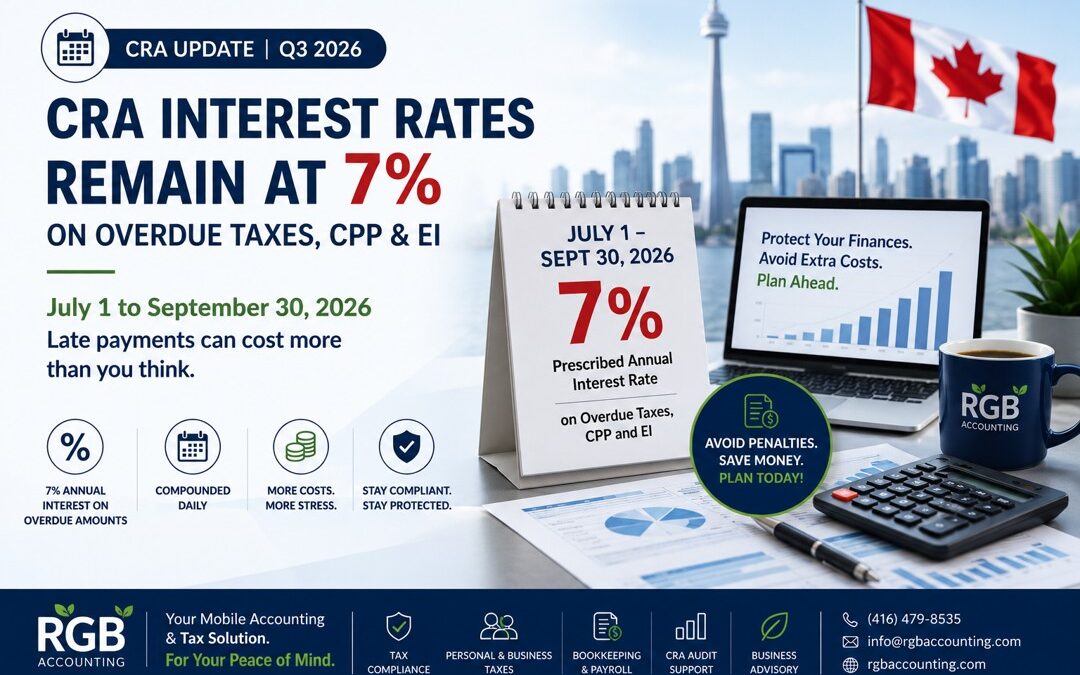
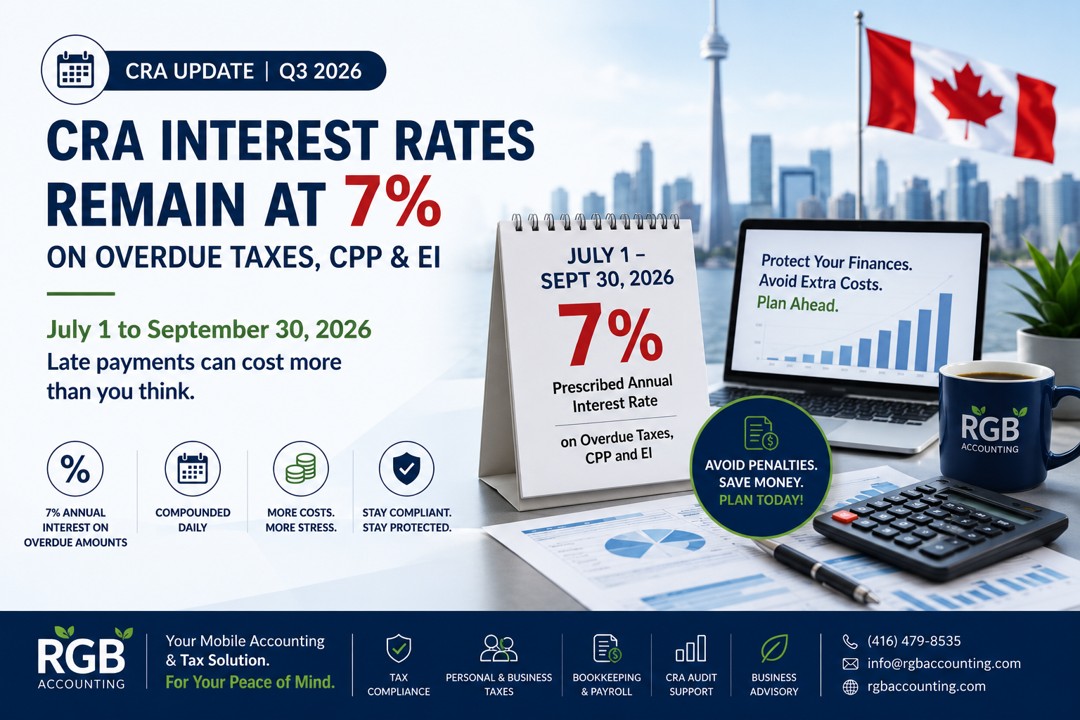
H1: CRA Interest Rates Remain at 7% for Q3 2026: Why Late Tax Payments Can Cost More Than You Think
As of July 1, 2026, the Canada Revenue Agency (CRA) continues to apply an annual interest rate of 7% on overdue taxes, Canada Pension Plan (CPP) contributions, and Employment Insurance (EI) premiums for the third quarter of 2026, which runs through September 30, 2026. While many taxpayers focus primarily on filing deadlines, the cost of paying late can sometimes have a greater financial impact than anticipated.
At RGB Accounting, one of our core values is helping our clients make informed decisions proactively, rather than reacting after costs have already accumulated. Understanding how CRA interest charges work is an important part of protecting your finances, maintaining compliance, and achieving peace of mind.
What Are CRA Prescribed Interest Rates?
The CRA reviews its prescribed interest rates every calendar quarter. These rates apply to amounts owed to the CRA, as well as to certain amounts the CRA owes to taxpayers. For the period from July 1 to September 30, 2026, the prescribed rates remain unchanged from the previous quarter.
| Amount | Annual Interest Rate |
|---|---|
| Overdue taxes, CPP and EI | 7% |
| Individual taxpayer overpayments | 5% |
| Corporate taxpayer overpayments | 3% |
| Prescribed shareholder and employee loan benefits | 3% |
The interest rate charged on overdue taxes is calculated by adding four percentage points to the CRA’s prescribed rate, which remains at 3% for the fifth consecutive quarter.
Why Should Taxpayers Care?
Many taxpayers assume that paying their tax balance a few months later will not significantly affect their finances. Unfortunately, CRA interest charges can accumulate faster than expected because they are:
- Charged automatically
- Calculated daily
- Compounded continuously
- Applied to most unpaid balances
For example, an outstanding tax balance of $20,000 could generate approximately $1,400 annually in interest charges alone, before considering any additional penalties that may apply.
In other words, delaying a payment to the CRA can sometimes cost more than certain commercial financing alternatives.
The Hidden Cost for Small Businesses
For small business owners, cash flow management often requires balancing multiple priorities:
- Employee salaries
- Commercial rent
- Supplier invoices
- Loan repayments
- GST/HST remittances
- Payroll source deductions
- Corporate income taxes
When cash flow becomes constrained, business owners sometimes postpone payments to the CRA. However, this strategy can become costly very quickly.
Payroll Remittances
Amounts withheld from employees for:
- Income tax
- CPP contributions
- EI premiums
are considered trust funds held on behalf of the Government of Canada. Failure to remit these amounts on time can result in:
- Interest charges
- Penalties
- Collection actions
- Potential director liability in certain circumstances
GST/HST Obligations
Similarly, GST/HST collected from customers belongs to the government until remitted. Delaying these remittances can trigger:
- Interest charges
- Late filing penalties
- Increased scrutiny from the CRA
Individuals Can Also Face Significant Costs
Individuals frequently encounter unexpected tax balances due to:
- Self-employment income
- Rental properties
- Investment income
- Capital gains
- Foreign income
- Insufficient tax withholdings
Even modest balances can grow significantly if they remain unpaid for extended periods. Moreover, interest generally continues to accrue while reassessments, objections, or reviews are underway.
What Should You Do If You Cannot Pay Your Taxes?
If you cannot pay your tax balance in full, ignoring the situation is rarely the best option.
1. File Your Return On Time
Filing your return by the deadline helps avoid late-filing penalties, which are separate from interest charges.
2. Pay What You Can
Interest applies only to the unpaid portion of the balance. Even partial payments can substantially reduce future interest costs.
3. Review Your Cash Flow Strategy
Businesses should regularly evaluate:
- Tax instalments
- GST/HST reserves
- Payroll obligations
- Corporate tax provisions
4. Seek Professional Advice Early
Professional tax advice may help identify:
- Payment arrangements
- Cash flow improvements
- Compliance strategies
- Potential taxpayer relief options
Prevention Is Almost Always Less Expensive Than Correction
At RGB Accounting, we believe that effective tax planning is not just about minimizing taxes—it’s about avoiding unnecessary costs, penalties, and stress.
Some practical strategies include:
✓ Maintaining current bookkeeping records
✓ Performing regular payroll reconciliations
✓ Monitoring GST/HST obligations monthly
✓ Setting aside funds for taxes throughout the year
✓ Reviewing instalment requirements proactively
✓ Seeking professional guidance before issues escalate
Final Thoughts
The CRA’s prescribed interest rate of 7% on overdue taxes, CPP contributions, and EI premiums remains in effect from July 1 through September 30, 2026, serving as an important reminder that delayed tax payments can become much more expensive than many taxpayers expect.
Whether you are an employee, a self-employed professional, an investor, or a business owner, proactive planning and timely compliance remain the most effective ways to protect your finances and achieve peace of mind.
Related Articles You May Find Helpful
If you found this article useful, you may also be interested in exploring other topics available on the RGB Accounting blog, including:
- How to Prepare for a CRA Audit or Review
- The Ultimate Bookkeeping Checklist for Canadian Small Businesses
- Cash Flow Management for Canadian Entrepreneurs
- Smart Tax Planning Strategies for Incorporated Businesses
- Understanding Payroll Deductions in Canada
Exploring related articles can help you develop a more comprehensive understanding of Canadian tax compliance, financial planning, and business management, and stay informed about changes that may affect your personal or business finances.
Need Help Managing Your Tax Obligations?
At RGB Accounting, we help individuals, entrepreneurs, and incorporated businesses across Canada navigate tax compliance with confidence. Whether you need assistance with personal taxes, corporate taxes, bookkeeping, payroll, CRA reviews, or business advisory services, our team is here to help.
Avoid unnecessary interest, penalties, and surprises by planning proactively.
📞 Phone: (416) 479-8535
📧 Email: [email protected]
🌐 Website: RGB Accounting
RGB Accounting — Your Mobile Accounting & Tax Solution. For Your Peace of Mind.
Newsletters
Love Is in the Numbers ❤️ February Update from RGB Accounting
NewslettersEvents & SponsorshipArticles & Publications
Start 2026 with Confidence — RGB Accounting Expands Across Canada.
NewslettersEvents & SponsorshipArticles & Publications
Closing the Year with Purpose: RGB’s 2025 Journey
NewslettersEvents & SponsorshipArticles & Publications
Growth with Purpose — Remembering Our Roots, Reaching New Markets
NewslettersEvents & SponsorshipArticles & Publications
October at RGB Accounting: Gratitude, Growth & Smart Financial Moves 🍁
NewslettersEvents & SponsorshipArticles & Publications
Events & Sponsorship
Toronto Entrepreneurs Conference @ Mississauga
May 08, 2019 Our B.E.S.T. (Business Entrepreneurs Services Team) Group has participated in this event for first time. Toronto Entrepreneurs Conference and Trade Show is the largest Entrepreneurs event in Canada. The event which targets business owners, partners or...
Hispanic Fiesta 2018
September 04, 2018 RGB Accounting will participate in this event for a second year in a row. Hispanic Fiesta will be held at Mel Lastman Square in Toronto during the Labour Day Weekend, August 31st, Sept. 1, 2, & 3, 2018. Hispanic Fiesta is a four-day celebration...
Secure Your Future Seminar 2018
June 20, 2018 This event gathered business owners running a small or medium-sized business, self-employed and incorporated businesses willing to learn tax saving strategies to help them utilize their company assets to secure their retirement. We are proud of having...
2nd Latino Business Expo Show
May 19, 2018 The 2nd Latino Business Expo Show held on May 19th at Daniels Spectrum gathered a wide range of entrepreneurs and business owners avid to learn how to take their businesses to the next level. RGB Accounting participated as vendor and speaker at this...
Hispanic Fiesta 2017
September 04, 2017 Hispanic Fiesta, a celebration of Spanish and Latin-American: Arts, Food, Music and Entertainment, is a four-day celebration filled with the splendid sounds, tempting treats and colorful culture featuring 300 local, national and International...
Articles & Publications
U.S. Brokerage Account: I Never Withdrew the Money… So Why Would I Owe Tax?
U.S. Brokerage Account: I Never Withdrew the Money… So Why Would I Owe Tax? Understanding realized and unrealized gains on foreign investment accounts By Roberto Belingueres, Founder & CEO, RGB Accounting | 7-minute read As more Canadians invest internationally...
Foreign Investments, U.S. Brokerage Accounts, and Canadian Taxes: The 10 Most Common Mistakes We See
Foreign Investments, U.S. Brokerage Accounts, and Canadian Taxes: The 10 Most Common Mistakes We See By Roberto Belingueres, Founder & CEO, RGB Accounting Estimated reading time: 10-minute read A practical cross-border tax guide for Canadian residents, business...
Advanced Canada Workers Benefit 2026
Advanced Canada Workers Benefit 2026: Payment Dates, Eligibility and Filing Rules For Canadians who work but earn a modest income, the Canada Workers Benefit (CWB) can provide meaningful tax relief. The Advanced Canada Workers Benefit (ACWB) makes part of that support...
Canada Child Benefit 2026: New Amounts, Payment Dates and Rules Families Need to Know
Canada Child Benefit 2026: New Amounts, Payment Dates and Rules Families Need to Know The Canada Child Benefit (CCB) remains one of Canada’s most important supports for families with children under 18. Beginning with the July 2026 payment, eligible families may...
Ontario Trillium Benefit 2026: Why Updating Your CRA Information Matters
Ontario Trillium Benefit Payment on July 10, 2026: Why Keeping Your CRA Information Updated Matters For millions of Ontario residents, July marks the beginning of a new Ontario Trillium Benefit (OTB) payment year, with the first payment scheduled for July 10, 2026....