
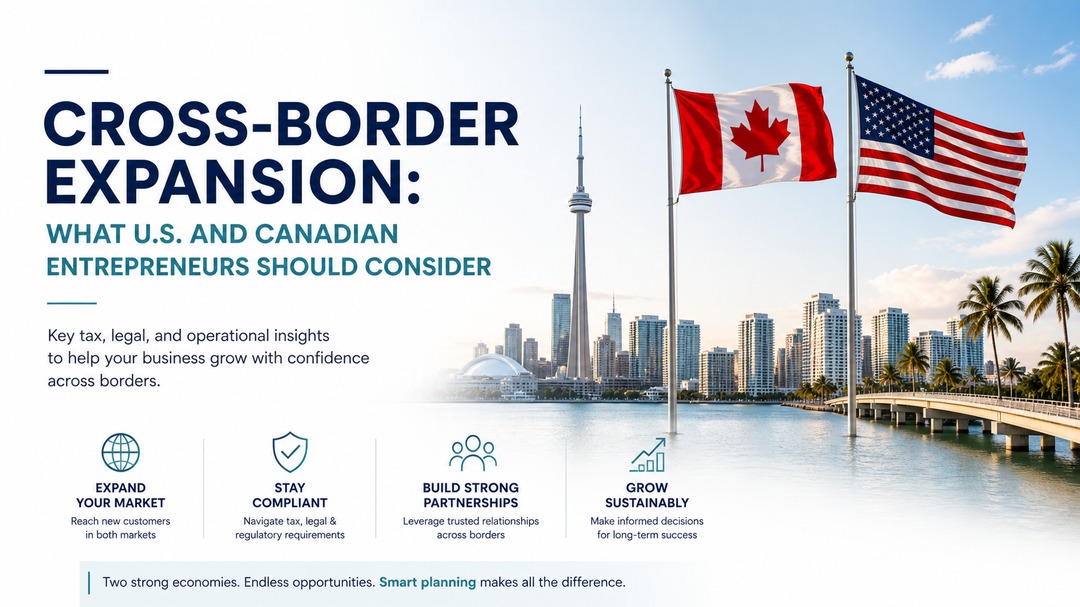
Cross-Border Expansion: What U.S. and Canadian Entrepreneurs Should Consider
A Practical Guide for Businesses Growing Between Canada and the United States
Expanding Across Borders: Opportunity Meets Complexity
Imagine Luis, an entrepreneur based in Miami, whose e-commerce business has gained traction among Canadian customers. At the same time, Sofia, a consultant in Toronto, begins receiving inquiries from clients in Florida. Both see growth opportunities beyond their borders—but quickly realize that expanding internationally involves more than sales and logistics.
Cross-border expansion between Canada and the United States is one of the most powerful ways to scale a business. However, it also introduces regulatory, tax, and operational considerations that require careful planning.
For entrepreneurs operating between markets like Miami and Toronto, success depends not only on strategy but also on compliance, structure, and cultural awareness.
Why Cross-Border Planning Matters Early
Many businesses begin selling internationally before fully understanding their reporting obligations. While early revenue growth is exciting, it can also trigger:
- Unexpected tax filings
- Regulatory obligations
- Withholding requirements
- Reporting responsibilities in multiple jurisdictions
Planning early allows entrepreneurs to expand with confidence rather than reacting to compliance risks later.
Proper cross-border structuring can unlock:
- Access to new markets
- Stronger investor positioning
- Operational flexibility
- Risk mitigation
- Sustainable long-term growth
Canada–U.S. Expansion: The Most Common Scenarios
Cross-border activity typically falls into one of these categories:
Canadian Business Expanding into the U.S.
This often includes:
- Selling goods to U.S. customers
- Opening a U.S. office or warehouse
- Hiring U.S.-based employees
- Working with U.S. contractors
Key considerations:
- S. tax presence (nexus)
- State-level obligations
- Sales tax compliance
- Payroll reporting requirements
U.S. Business Expanding into Canada
Common examples include:
- Providing services to Canadian clients
- Selling through Canadian platforms
- Establishing Canadian operations
- Hiring Canadian workers
Key considerations:
- Canadian corporate tax requirements
- GST/HST registration thresholds
- Provincial tax rules
- Payroll compliance
Digital and Remote Businesses Operating in Both Countries
This increasingly common model includes:
- SaaS platforms
- Consulting firms
- E-commerce businesses
- Professional services
Even without physical offices, businesses may still trigger reporting obligations.
Structuring for Cross-Border Growth
Choosing the right structure is one of the most important decisions entrepreneurs make when expanding internationally.
Common options include:
Operating Through a Foreign Entity
A Canadian company may:
- Register a U.S. subsidiary
- Create a U.S. branch
- Establish partnerships with U.S. entities
Similarly, a U.S. company entering Canada may:
- Form a Canadian subsidiary
- Register as a foreign corporation
- Establish Canadian payroll accounts
Each option carries different tax and liability implications.
Understanding Permanent Establishment Risk
One of the most critical cross-border concepts is permanent establishment (PE).
A PE may be created when:
- A business has a physical location
- Employees operate regularly in another country
- Contracts are negotiated or executed locally
When a PE exists, tax obligations may arise in that jurisdiction.
Understanding PE risk early prevents unexpected liabilities.
Tax Considerations for Cross-Border Entrepreneurs
Taxation is often the most complex part of international expansion.
Key areas to evaluate include:
Corporate Tax Obligations
Businesses operating in multiple jurisdictions may need to:
- File corporate tax returns in both countries
- Allocate income properly
- Maintain structured financial reporting
Improper allocation can lead to:
- Double taxation
- Penalties
- Increased audit exposure
Sales Taxes: GST/HST vs U.S. Sales Tax
Canada uses:
- GST/HST systems
The United States uses:
- State-level sales taxes
This difference creates complexity.
Businesses must determine:
- Where tax must be collected
- When registration is required
- How to report transactions correctly
Payroll and Contractor Reporting
Hiring across borders introduces:
- Withholding obligations
- Worker classification rules
- Payroll remittance responsibilities
Misclassification risks include:
- Penalties
- Back taxes
- Compliance audits
Financial Infrastructure: Building Systems That Scale
Cross-border businesses require a strong financial infrastructure.
Recommended tools include:
- Multi-currency accounting systems
- Integrated payroll platforms
- Automated tax tracking tools
- Secure document workflows
Cloud-based systems improve:
- Transparency
- Reporting accuracy
- Real-time decision-making
Cultural and Multilingual Strategy Matters
Expanding between Miami and Canada involves more than regulatory compliance—it also requires cultural alignment.
Successful cross-border businesses recognize:
- Language differences
- Communication styles
- Business etiquette
- Customer expectations
In markets like Miami, where Spanish-speaking communities play a major role, multilingual support becomes a competitive advantage.
Similarly, Canada’s diverse population benefits from culturally informed service delivery.
Businesses that invest in multicultural communication often experience:
- Higher trust
- Better client retention
- Stronger community engagement
Advisory Insights: Common Cross-Border Mistakes
Many cross-border challenges are preventable with structured planning.
Here are the most frequent issues:
Expanding Without Professional Guidance
Some founders attempt to manage cross-border operations independently.
This often results in:
- Missed filings
- Reporting errors
- Increased compliance risk
Cross-border activity requires coordinated advisory support.
Ignoring Tax Treaty Implications
Canada and the United States maintain a tax treaty that affects:
- Withholding rules
- Income allocation
- Double taxation prevention
Failure to apply treaty provisions correctly can create avoidable liabilities.
Overlooking State and Provincial Rules
In the United States:
- Each state may impose different tax obligations.
In Canada:
- Provinces maintain varying regulatory requirements.
Understanding regional rules is essential.
Delaying Compliance Setup
Waiting to establish reporting systems creates risk.
Businesses should implement:
- Accounting workflows
- Payroll structures
- Tax reporting systems
before expansion accelerates.
Case Examples: Cross-Border Lessons in Action
Real-world examples illustrate the importance of planning.
Case 1 — Miami-Based E-Commerce Expanding to Canada
A growing retailer began selling into Canadian markets without registering for GST/HST.
Result:
- Unexpected compliance requirements
- Delayed reporting
- Increased administrative workload
Lesson:
Register early and monitor thresholds carefully.
Case 2 — Toronto Consultant Serving U.S. Clients
A Canadian consultant began working with U.S. clients, triggering reporting obligations in multiple states.
Result:
- Additional filings
- Increased compliance complexity
Lesson:
Understand nexus risk before expanding services.
Case 3 — Multicultural Advisory Success
A bilingual consulting firm serving Spanish-speaking clients in Miami and Toronto implemented structured cross-border accounting systems early on.
Result:
- Smooth expansion
- Improved reporting accuracy
- Stronger client trust
Lesson:
Multilingual advisory strengthens cross-border operations.
Strategic Readiness Checklist for Entrepreneurs
Before expanding across borders, consider:
- Do you understand your tax obligations in both countries?
- Is your accounting system prepared for multi-jurisdiction reporting?
- Have you evaluated permanent establishment risks?
- Do you have multilingual support where needed?
- Are your contracts structured for international operations?
Preparation reduces uncertainty and improves decision-making.
The Future of Cross-Border Growth
Global expansion is no longer limited to large corporations.
Today:
- Small businesses scale internationally
- Digital platforms enable global reach
- Multicultural markets drive new opportunities
Entrepreneurs who build structured, compliant systems early gain a lasting advantage.
Cross-border growth is not just expansion—it is strategic transformation.
Moving Forward With Confidence
Expanding between Canada and the United States, particularly between business hubs such as Toronto and Miami, creates significant growth opportunities.
However, success depends on:
- Structure
- Compliance
- Cultural awareness
- Strategic advisory
At RGB Accounting, we support entrepreneurs navigating cross-border growth by combining technical expertise with multicultural understanding—helping businesses expand with confidence, clarity, and long-term sustainability.
If your business is planning to expand across borders, now is the time to build the right foundation.
Source: CRA
Newsletters
Love Is in the Numbers ❤️ February Update from RGB Accounting
NewslettersEvents & SponsorshipArticles & Publications
Start 2026 with Confidence — RGB Accounting Expands Across Canada.
NewslettersEvents & SponsorshipArticles & Publications
Closing the Year with Purpose: RGB’s 2025 Journey
NewslettersEvents & SponsorshipArticles & Publications
Growth with Purpose — Remembering Our Roots, Reaching New Markets
NewslettersEvents & SponsorshipArticles & Publications
October at RGB Accounting: Gratitude, Growth & Smart Financial Moves 🍁
NewslettersEvents & SponsorshipArticles & Publications
Events & Sponsorship
Toronto Entrepreneurs Conference @ Mississauga
May 08, 2019 Our B.E.S.T. (Business Entrepreneurs Services Team) Group has participated in this event for first time. Toronto Entrepreneurs Conference and Trade Show is the largest Entrepreneurs event in Canada. The event which targets business owners, partners or...
Hispanic Fiesta 2018
September 04, 2018 RGB Accounting will participate in this event for a second year in a row. Hispanic Fiesta will be held at Mel Lastman Square in Toronto during the Labour Day Weekend, August 31st, Sept. 1, 2, & 3, 2018. Hispanic Fiesta is a four-day celebration...
Secure Your Future Seminar 2018
June 20, 2018 This event gathered business owners running a small or medium-sized business, self-employed and incorporated businesses willing to learn tax saving strategies to help them utilize their company assets to secure their retirement. We are proud of having...
2nd Latino Business Expo Show
May 19, 2018 The 2nd Latino Business Expo Show held on May 19th at Daniels Spectrum gathered a wide range of entrepreneurs and business owners avid to learn how to take their businesses to the next level. RGB Accounting participated as vendor and speaker at this...
Hispanic Fiesta 2017
September 04, 2017 Hispanic Fiesta, a celebration of Spanish and Latin-American: Arts, Food, Music and Entertainment, is a four-day celebration filled with the splendid sounds, tempting treats and colorful culture featuring 300 local, national and International...
Articles & Publications
U.S. Brokerage Account: I Never Withdrew the Money… So Why Would I Owe Tax?
U.S. Brokerage Account: I Never Withdrew the Money… So Why Would I Owe Tax? Understanding realized and unrealized gains on foreign investment accounts By Roberto Belingueres, Founder & CEO, RGB Accounting | 7-minute read As more Canadians invest internationally...
Foreign Investments, U.S. Brokerage Accounts, and Canadian Taxes: The 10 Most Common Mistakes We See
Foreign Investments, U.S. Brokerage Accounts, and Canadian Taxes: The 10 Most Common Mistakes We See By Roberto Belingueres, Founder & CEO, RGB Accounting Estimated reading time: 10-minute read A practical cross-border tax guide for Canadian residents, business...
Advanced Canada Workers Benefit 2026
Advanced Canada Workers Benefit 2026: Payment Dates, Eligibility and Filing Rules For Canadians who work but earn a modest income, the Canada Workers Benefit (CWB) can provide meaningful tax relief. The Advanced Canada Workers Benefit (ACWB) makes part of that support...
Canada Child Benefit 2026: New Amounts, Payment Dates and Rules Families Need to Know
Canada Child Benefit 2026: New Amounts, Payment Dates and Rules Families Need to Know The Canada Child Benefit (CCB) remains one of Canada’s most important supports for families with children under 18. Beginning with the July 2026 payment, eligible families may...
Ontario Trillium Benefit 2026: Why Updating Your CRA Information Matters
Ontario Trillium Benefit Payment on July 10, 2026: Why Keeping Your CRA Information Updated Matters For millions of Ontario residents, July marks the beginning of a new Ontario Trillium Benefit (OTB) payment year, with the first payment scheduled for July 10, 2026....