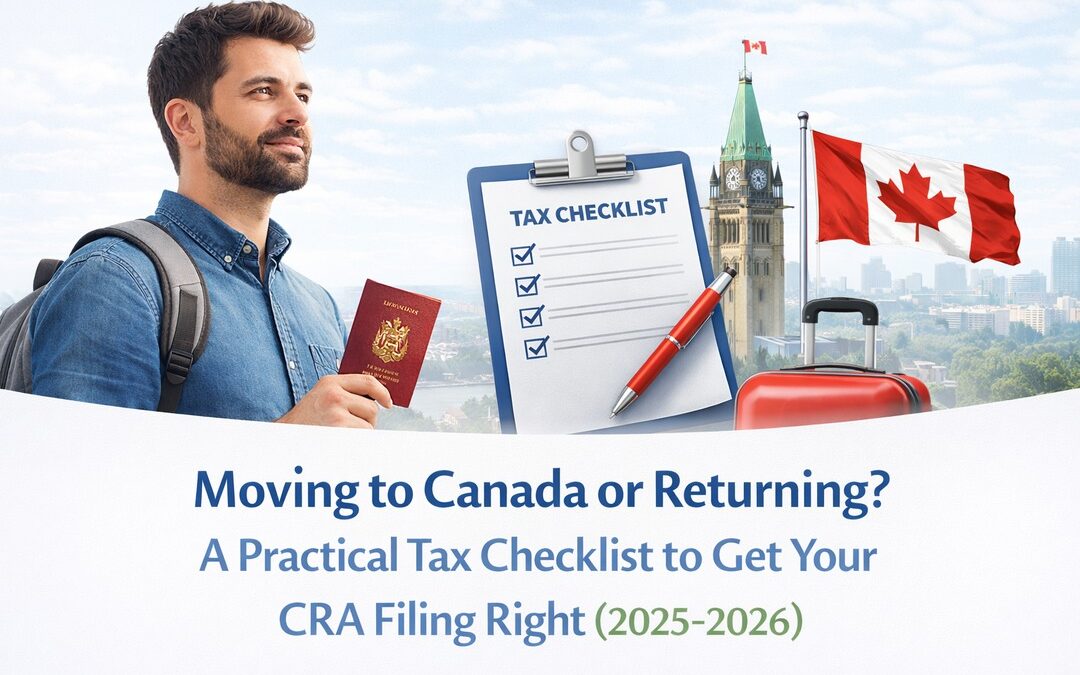
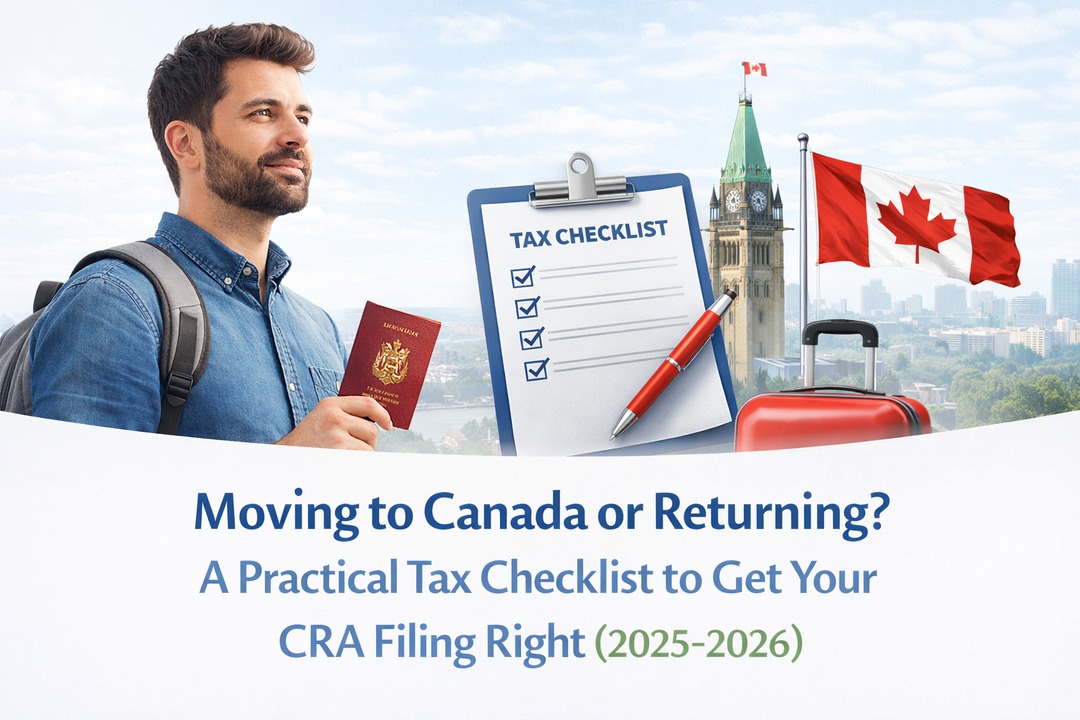
Moving to Canada or Returning? A Practical Tax Checklist to Get Your CRA Filing Right (2025–2026)
If you’re new to Canada or moving back after living abroad, your first Canadian tax return can feel confusing—especially because Canadian taxes are based on tax residency, not citizenship. The good news: with the right checklist and a clear “arrival/return date,” you can file correctly, protect your benefits, and avoid unpleasant surprises later.
Below is a client-friendly, CRA-aligned guide you can use as your first-return roadmap.
Start with the most important question: Are you a Canadian tax resident?
In Canada, what you report (and how) depends primarily on your residency status for tax purposes. CRA focuses heavily on your residential ties (home, spouse/dependants, etc.) and your overall facts and circumstances.
Common categories you may fall into
- Resident (including “factual resident”)
- Non-resident
- Deemed resident / deemed non-resident (often involving tax treaties)
- Part-year resident (very common in the year you arrive or return)
CRA maintains a central guide for determining residency status and refers to its detailed residency folio for interpretation.
Tip: If your situation is not straightforward, CRA may provide an opinion if you submit the appropriate residency determination form (e.g., NR74, which CRA commonly references in its residency materials).
Know your “arrival/return date” and what it changes
For most newcomers/returnees, the year you land back in Canada is a part-year filing year. Practically, that means:
- You typically report worldwide income only for the part of the year you are a Canadian tax resident (based on your facts and ties).
- Your eligibility for certain credits/benefits (and the amounts) often depends on income information you provide for the relevant period.
CRA has a dedicated section for newcomers and another for individuals entering or leaving Canada, which is a helpful starting point.
Gather the documents CRA (and your accountant) will actually need
Identity & status
- SIN (or confirmation of application)
- Immigration/entry documents (PR, work/study permit, landing documents)
- Date you established residence in Canada (lease, purchase, utility start date)
Canadian income slips (as applicable)
- T4 (employment), T4A (certain payments), T5 (investment), etc.
- If you don’t have everything yet, you can still prepare early—don’t guess.
Foreign income & foreign tax documents (very important)
For the year you move/return, collect:
- Foreign employment income statements/payslips
- Foreign investment statements (dividends, interest, capital gains)
- Foreign pension statements
- Foreign tax returns and proof of foreign taxes paid (for potential foreign tax credits)
Understand what income to report (newcomers and returnees)
If you are a resident in Canada for tax purposes
Residents (including deemed residents) are generally taxable on worldwide income for the period they are resident. CRA’s residency folio explicitly reflects this concept for deemed residents as well.
If you are a non-resident
Non-residents generally report only certain Canadian-source income, and in many cases, Canadian payers withhold non-resident tax (Part XIII withholding) on specific types of income.
Don’t overlook foreign asset reporting (T1135)
A common “gotcha” for people returning to Canada: once you’re a Canadian resident, you may have foreign reporting obligations if you own “specified foreign property” above the threshold.
CRA states that Canadian-resident individuals (and certain entities) must file Form T1135 if at any time in the year they own specified foreign property with a cost amount of more than $100,000.
Key nuance: Even if you drop below the $100,000 threshold by year-end—or sell the assets—you can still have a filing obligation if you met the threshold at any point during the year.
Examples that often trigger T1135 for returnees:
- Foreign brokerage accounts and stocks held abroad
- Foreign bank accounts with significant balances
- Foreign real estate held as specified foreign property (with important exceptions/definitions)
Filing your first return matters for benefits (even if income is low)
For many people new to Canada, filing is not just about tax—it’s about benefits and credits. CRA emphasizes that filing on time helps avoid delays or interruptions to benefit and credit payments, and it highlights standard filing/payment deadlines in its first-time filer guidance.
Practical takeaway: Even if you earn little income, filing can be essential to activate or maintain benefits.
CRA setup checklist (do this early to avoid delays)
These steps reduce refund delays and CRA mail back-and-forth:
- Set up CRA My Account (when eligible)
- Register for direct deposit
- Keep your address and marital status current with CRA (important for benefit calculations)
- If you use an accountant, formally authorize your representative so they can communicate with CRA on your behalf (CRA includes authorization as a common “how do I…” task for international/residency situations).
Common mistakes we see (and how to avoid them)
- Assuming residency = citizenship
Residency is about ties and facts; it’s not automatic. - Not tracking the correct “start date” of residency
The date you re-establish significant ties can change what income is reportable. - Forgetting foreign income documents
Missing foreign slips leads to amended returns later. - Ignoring T1135
This is a frequent compliance issue for returning residents with overseas accounts/investments. - Waiting too long to file
Filing on time can protect benefits and avoid penalties/interest if tax is owing.
FAQ
Do I need to file a Canadian tax return in my first year in Canada?
Often yes—especially if you want to access or continue CRA benefits/credits. CRA provides a newcomer’s guide and specific instructions for completing a return.
When I return to Canada, do I report income from the whole year?
Many returnees file as part-year residents; what you report depends on when you became a Canadian tax resident based on your ties and facts. CRA’s residency guidance is the starting point.
I had over $100,000 in foreign assets earlier in the year, but not at year-end. Do I still file T1135?
CRA says yes—if you met the threshold at any time during the year, you may still have to file and report specified foreign property held during the year.
Source: CRA
Newsletters
Love Is in the Numbers ❤️ February Update from RGB Accounting
NewslettersEvents & SponsorshipArticles & Publications
Start 2026 with Confidence — RGB Accounting Expands Across Canada.
NewslettersEvents & SponsorshipArticles & Publications
Closing the Year with Purpose: RGB’s 2025 Journey
NewslettersEvents & SponsorshipArticles & Publications
Growth with Purpose — Remembering Our Roots, Reaching New Markets
NewslettersEvents & SponsorshipArticles & Publications
October at RGB Accounting: Gratitude, Growth & Smart Financial Moves 🍁
NewslettersEvents & SponsorshipArticles & Publications
Events & Sponsorship
Toronto Entrepreneurs Conference @ Mississauga
May 08, 2019 Our B.E.S.T. (Business Entrepreneurs Services Team) Group has participated in this event for first time. Toronto Entrepreneurs Conference and Trade Show is the largest Entrepreneurs event in Canada. The event which targets business owners, partners or...
Hispanic Fiesta 2018
September 04, 2018 RGB Accounting will participate in this event for a second year in a row. Hispanic Fiesta will be held at Mel Lastman Square in Toronto during the Labour Day Weekend, August 31st, Sept. 1, 2, & 3, 2018. Hispanic Fiesta is a four-day celebration...
Secure Your Future Seminar 2018
June 20, 2018 This event gathered business owners running a small or medium-sized business, self-employed and incorporated businesses willing to learn tax saving strategies to help them utilize their company assets to secure their retirement. We are proud of having...
2nd Latino Business Expo Show
May 19, 2018 The 2nd Latino Business Expo Show held on May 19th at Daniels Spectrum gathered a wide range of entrepreneurs and business owners avid to learn how to take their businesses to the next level. RGB Accounting participated as vendor and speaker at this...
Hispanic Fiesta 2017
September 04, 2017 Hispanic Fiesta, a celebration of Spanish and Latin-American: Arts, Food, Music and Entertainment, is a four-day celebration filled with the splendid sounds, tempting treats and colorful culture featuring 300 local, national and International...
Articles & Publications
Changing Your Payroll Provider: A Small-Business Transition Guide and Checklist
Changing Your Payroll Provider: A Small-Business Transition Guide and Checklist By Roberto Belingueres, Founder & CEO, RGB Accounting Estimated reading time: 14 minutes Introduction: Why a Payroll Change Can Become a Compliance Problem Changing or cancelling a...
AI for Canadian Small Businesses: How to move faster without losing financial control
AI for Canadian small businesses: How to move faster without losing financial control A Canadian small business can adopt artificial intelligence with less risk by starting with a specific operational problem, establishing a financial baseline, running a limited pilot...
Buying a Business in Canada: Seven financial tests for resilient growth
Buying a business in Canada: Seven financial tests for resilient growth This article is for you if you are a business entity operating in Canada. Before buying a business in Canada, a buyer should test strategic fit, whether earnings convert to cash, working-capital...
U.S. Brokerage Account: I Never Withdrew the Money… So Why Would I Owe Tax?
U.S. Brokerage Account: I Never Withdrew the Money… So Why Would I Owe Tax? Understanding realized and unrealized gains on foreign investment accounts By Roberto Belingueres, Founder & CEO, RGB Accounting | 7-minute read As more Canadians invest internationally...
Foreign Investments, U.S. Brokerage Accounts, and Canadian Taxes: The 10 Most Common Mistakes We See
Foreign Investments, U.S. Brokerage Accounts, and Canadian Taxes: The 10 Most Common Mistakes We See By Roberto Belingueres, Founder & CEO, RGB Accounting Estimated reading time: 10-minute read A practical cross-border tax guide for Canadian residents, business...