
The Canada Revenue Agency (CRA) launched the Canada Emergency Response Benefit (CERB) as the flagship COVID-19 program by the Canadian government in 2020. CERB became a lifeline for Canadians who lost income due to the pandemic. The program ended on September 27, 2020, and made way for CERB replacements.
The federal government revamped the Employment Insurance (EI) system and introduced the Canada Recovery Benefit (CRB) to transition Canadians still in need of financial aid. With no visible end to the pandemic, despite hopeful developments on the vaccine front, the government announced two major updates for EI and CRB.
Maximum duration
Many CRB recipients are due to exhaust their benefits on March 27, 2021. The government’s announcement to update CRB and EI came right on time. One of the changes introduced by the CRA will be an extension of CRB from the original 26 weeks to 38 weeks. For regular EI benefits, the CRA has extended the period to 50 weeks for claims made between September 27, 2020, and September 25, 2021.
The federal government also extended the Canada Recovery Caregiving Benefit (CRCB) and Canada Recovery Sick Benefit (CRSB). The CRCB duration is also 36 weeks after the update, while the CRSB has been extended from two to four weeks.
CRA cash benefit amount
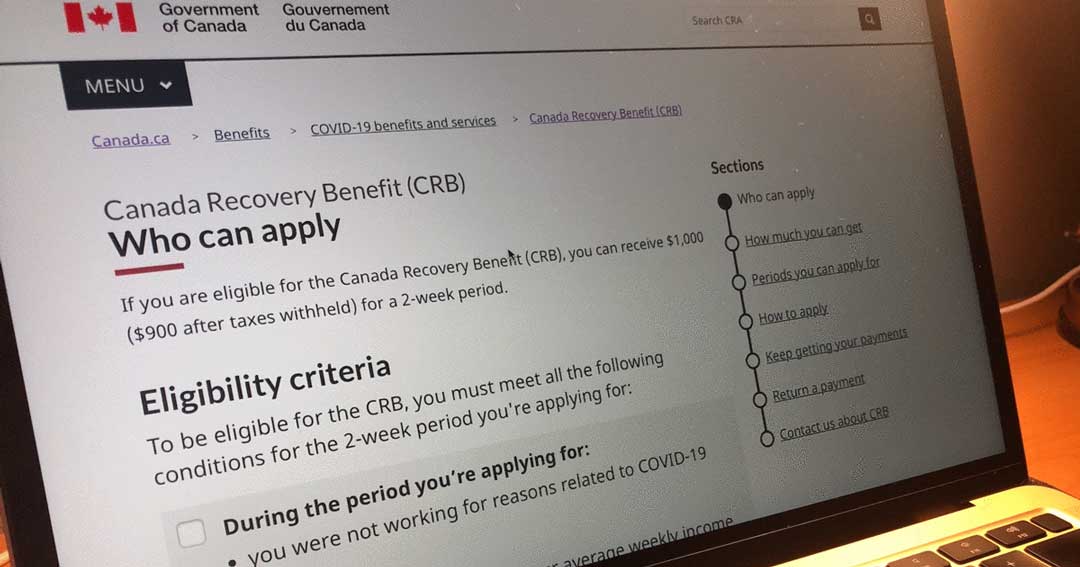
The CRA pays $1,000 for each two-week CRB eligibility period, which is actually $900 after the 10% withholding tax is deducted at the source. For self-employed individuals who prefer access to their EI benefits through Service Canada, the government has reduced the self-employed income threshold (for 2020 earnings) from $7,555 to $5,000.
You can earn income while you receive CRB, provided that your annual income for the calendar year will not go over $38,000. You will need to pay 50% of each dollar of your income that goes above $38,000.
If you qualify for the EI benefit, the minimum amount you can receive per week is $500 (subject to a 10% tax on payment), but some people may be eligible to receive up to $573 per week, depending on their previous income. The proceeds for both CRSB and CRCB are $450 per week (subject to a 10% withholding tax upon payment).
Source: CRA
Newsletters
No Results Found
The page you requested could not be found. Try refining your search, or use the navigation above to locate the post.
Events & Sponsorship
Talent Kids Event 2017
August 19, 2017 RGB Accounting has proudly sponsored the 2017 Talent Kids event organized by Pecora Events on August 19th. RGB Accounting wants to thank organizers, presenters, judges, and all participants for making this a great event. Here we share some of the...
Los Nocheros USA/Canada Tour 2017
June 02, 2017 Argentina's biggest folkloric phenomenon arrived in Toronto, Canada to celebrate its 30 years trajectory. RGB Accounting was one of the sponsors of the event. More from our blog Newsletters Events & Sponsorship Articles &...
2nd Latin American Entrepreneur Conference
May 29, 2017 The Entrepreneur Conference was organized by the City of Toronto's Economic Development & Culture department in partnership with the Latin American Bi-Lateral Trade Initiative (LABTI) which consists of the Consulate Generals of Argentina, Brazil,...
Tax Season 2017 at La Liga Indoor Soccer
April 29, 2017 RGB Accounting has been sponsoring social events to promote cultural values in the hispanic community of Toronto and the GTA. The During the last tax season, RGB Accounting helped many individuals and small business owners to prepare their taxes,...
Articles & Publications
Canada Groceries and Essentials Benefit: Why Filing Your Taxes Matters More Than Ever in 2026
Canada Groceries and Essentials Benefit: Why Filing Your Taxes Matters More Than Ever in 2026 Beginning in July 2026, Canadians will start receiving payments under a newly enhanced federal benefit: the Canada Groceries and Essentials Benefit (CGEB). This new benefit...
CRA Interest Rates Remain at 7%: Why Late Tax Payments Can Cost More Than You Think in 2026
H1: CRA Interest Rates Remain at 7% for Q3 2026: Why Late Tax Payments Can Cost More Than You Think As of July 1, 2026, the Canada Revenue Agency (CRA) continues to apply an annual interest rate of 7% on overdue taxes, Canada Pension Plan (CPP) contributions, and...
Tax Updates That Impact Payroll, Innovation, and Capital Gains in Canada (2026)
Tax Updates That Impact Payroll, Innovation, and Capital Gains in Canada (2026) For Canadian entrepreneurs and SMEs, tax changes aren’t just “filing updates”—they can affect cash flow, hiring, innovation budgets, and long-term exit planning. In 2026, three topics...
Understanding Canada’s New Reporting Standards
Understanding Canada’s New Reporting Standards IFRS 18 and Sustainability Assurance (CSSA 5000) Mid-2026 is a practical turning point for Canadian finance teams—not because everything becomes mandatory overnight, but because two major frameworks are now final,...
From Startup to Corporation: Structuring for Sustainable Growth
From Startup to Corporation: Structuring for Sustainable Growth A Practical Guide for Founders Preparing for the Next Stage A Founder's Dilemma: When Growth Demands Structure Imagine Ana, a driven founder in Toronto who started her business as a side project. What...