

Analyzing Financial Statements: The Horizontal Method
The second method to analyze financial statements is the horizontal method. The horizontal method is used to analyze financial information in two fiscal years.
This method consists of comparing various financial statements, and it has a comparative evaluation between two years as less to identify the evolution of different accounts.
The method involves increasing and decreasing, a technique used to compare similar concepts on different dates. The object is to locate differences or inconsistent and analyze the accounts’ behavior year by year.
We determine if the variation is positive (increase) or negative (decrease).
To ensure a good analyze we recommend following the following steps:
Step #1
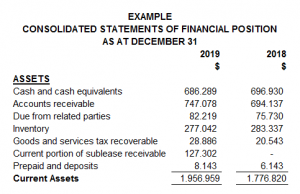
Having the financial statements in an Excel format will make it easier for the necessary calculations. Make sure you include the complete accounts next to their amounts and the two years correspondence. In the following example, we can see how it must look.
 |
Step #2
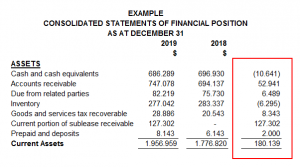
Include two columns next to the amounts inserted; the first one will be used to present the increases and decreases, and the second one will show the percentages.
The horizontal method takes each account’s value from the last year minus each account’s worth from the previous year.
For example, cash and cash equivalents from 2019 minus cash and its equivalents from 2018, as we can see as follow:
 |
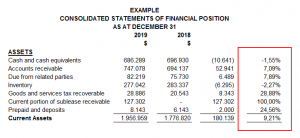
Then, the result is divided by the total of the account from the last year. In this case, the result was divided by the total cash and cash equivalent from 2019 (the most recent year), obtaining 1.55%.
 |
Step #3
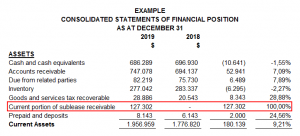
Once the percentages have been obtained, the user of the financial statements can select the account with more variation (a positive percentage if the account had an increase or a negative percentage if the account had a decrease) in the assets, liabilities, or income loss statement.
In the following example, we have the current portion of sublease receivable with 100% positive variation and cash and cash equivalents with 1.55% negative variation. The first have our special attention because it has more than 50%.
 |
Step #4
The analyst can start making questions about the variations; the first one could be which sublease did the company celebrate? In which operations or inversions the company expended cash?
You could have that information having an interview with the accounting department, the administrator, or even directly with the company’s owner, also. If the financial statement has been audited, you could read its notes.
With this method and the vertical method, it is essential to be sure about the accounts you are reviewing and investigate a lot about them. Make questions, look for supporting documents and call an expert if necessary.
Written by: Andrea Diaz
Related Articles:
Newsletters
No Results Found
The page you requested could not be found. Try refining your search, or use the navigation above to locate the post.
Events & Sponsorship
No Results Found
The page you requested could not be found. Try refining your search, or use the navigation above to locate the post.
Articles & Publications
Childcare & Dependant Credits in Canada: How to Maximize Your 2025 Tax Return
Childcare & Dependant Credits in Canada: How to Maximize Your 2025 Tax Return (Including Separated Parents) Learn how to claim childcare expenses on line 21400, when you can claim the eligible dependant amount on line 30400, and how separated/shared-custody...
Reporting Foreign Income and Foreign Assets in Canada (2025–2026): T1135, Foreign Tax Credits, and a CRA-Ready Checklist
Reporting Foreign Income and Foreign Assets in Canada (2025–2026): T1135, Foreign Tax Credits, and a CRA-Ready Checklist If you’re a Canadian tax resident and you earn money outside Canada—or you hold assets outside Canada—your tax return may require more than...
Rental Income Tax Guide Canada (2025–2026): Deductions, Repairs vs Capital, CCA, and CRA Red Flags
Rental Income Tax Guide Canada (2025–2026): Deductions, Repairs vs Capital, CCA, and CRA Red Flags Owning a rental property can be a great wealth-building strategy—but it also comes with tax rules that can trip up even careful landlords. The biggest issues we see are:...
Moving to Canada or Returning? A Practical Tax Checklist to Get Your CRA Filing Right (2025–2026)
Moving to Canada or Returning? A Practical Tax Checklist to Get Your CRA Filing Right (2025–2026) If you’re new to Canada or moving back after living abroad, your first Canadian tax return can feel confusing—especially because Canadian taxes are based on tax...
Canada Budget 2025 Overview
Canada Budget 2025 Overview (RGB Accounting Blog Article — updated and expanded with verified sources) Introduction Released on November 4, 2025, the federal Budget 2025 is framed around three themes: Build, Protect, and Empower Canada. The government’s narrative is...