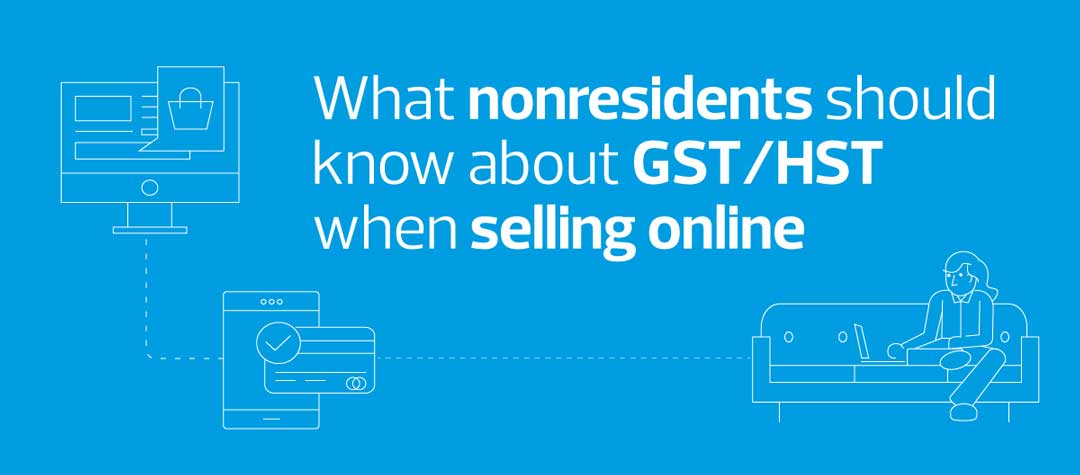
This article intends to illustrate how the new proposed Goods and Services/Harmonized Sales Tax (GST/HST) rules are to apply to the sale of goods made on July 1, 2021, or later, by a retailer that is a non-resident of Canada and not registered for GST/HST purposes, when the goods are stored in a fulfillment warehouse in Canada before being sold and delivered to Canadian consumers and only when those sales are made through a GST/HST registered distribution platform.
For this article, we will consider the following facts:
- A retailer located outside Canada imports goods into Canada to be stored in a fulfillment warehouse, waiting to be sold to Canadian consumers. When importing the goods into Canada, the retailer pays the 5% GST to Canadian customs calculated on the value for importing the goods.
- The nonresident retailer has no other presence in Canada and is not registered for GST/HST purposes.
- The retailer sells all its goods to Canadian consumers online through a GST/HST registered distribution platform.
In addition to storing the goods, the fulfillment warehouse also delivers the goods sold by the retailer directly to Canadian consumers.
New Rules
Under the new GST/HST rules coming into effect on July 1, 2021, every person that is a non-resident person (i.e., the retailer) that does not carry on business in Canada will not be required to register for GST/HST purposes when all the sales are made through a GST/HST registered specified distribution platform.
Instead, it is the operator of the specified distribution platform required to charge any applicable GST/HST on the sales it facilitates on behalf of the non-GST/HST registered retailer when the goods are delivered to the Canadian consumers from a place in Canada.
However, the “drop-shipment” rules may still apply to deem the fulfillment warehouse to have sold the goods to the non-GST/HST registered retailer at fair market value (i.e., at the price at which a retailer to the Canadian consumer sells the goods).
The purpose of this rule is to prevent the loss of tax revenue that would result otherwise on the sale of goods made by the non-GST/HST registered retailer to the Canadian consumer. This tax would be an unrecoverable cost to the retailer and would apply in addition to the GST/HST charged by the specified distribution platform to the Canadian consumer. To prevent the double incidence of taxes, including the tax charged by the fulfillment warehouse to the retailer, changes will be made to the current drop-shipment rules.
Distribution Platform Operator Certificate
New subsection 179(3.1) of the Excise Tax Act (ETA) will provide a new exception to the application of the general rule in subsection 179(1) in respect of the sale of goods, or service in respect of goods, that is made in Canada by a registrant to an unregistered non-resident person that is not a consumer of the goods or service.
This new subsection provides that, in certain circumstances, a certificate (referred to as a “distribution platform operator certificate”) may be issued that has the effect of nullifying the sale of goods that is deemed to have been made by the registrant (i.e., the fulfillment center) under subsection 179(1), thereby relieving the registrant from having to remit GST/HST on that deemed sale.
Who is a Distribution Platform Operator?
A distribution platform operator will be a person that controls or sets the essential elements of the transaction between the third-party vendor and the purchaser, for example, by providing listing services for the sale of goods and setting payment terms and delivery conditions.
If no such person exists, the operator will be a person that is involved, directly or through arrangements with third parties, in collecting, receiving or charging payment for the sale and transmitting payment to the third-party vendor. Examples of distribution platform operators could be Amazon or Shopify.
The certificate also has the effect of deeming the sale of the goods, or the sale of service in respect of the goods (other than a service of shipping the goods), to have been made outside of Canada. Therefore, the GST/HST is relieved of that sale by the registrant to the unregistered non-resident.
Conditions for Issuing a Certificate
New subsection 179(3.1) generally provides that a distribution platform operator certificate may be issued if the following conditions are satisfied:
- a registrant makes a sale in Canada of goods, a service of manufacturing or producing goods, or a commercial service in respect of goods (other than goods of a person that is resident in Canada) to an unregistered non-resident person that is not a consumer of the goods or service;
- the registrant causes the transfer of physical possession of those goods at a place in Canada to a consignee (i.e., the Canadian consumer) that is acquiring physical possession of the goods as the recipient of the sale of the goods;
- the sale of the goods is deemed, under new subsection 211.23(1) of the ETA, to have been made by a “distribution platform operator” (as defined in new subsection 211.1(1)) that is registered under Subdivision D of Division V of Part IX, and would, in the absence of subsection 211.23(1), have been made by an unregistered non-resident vendor;
- the unregistered non-resident vendor (i.e., the retailer) gives to the registrant (i.e., the fulfillment warehouse). The registrant retains a certificate that acknowledges that the consignee acquired physical possession of the goods as the sale recipient. The distribution platform operator is required to collect tax in respect of that sale, which states the distribution platform operator’s name and GST/HST registration number.
Additional Rules
Some additional rules will also apply.
The extra money — which is up to $1,200 in 2021 — will be paid out in four installments throughout the year, with the first two payments landing on May 28, 2021. The final two payments will be distributed on July 30 and October 29, 2021.
- Recovery of tax on inputs: Registered distribution platform operators would be eligible to claim input tax credits in respect of the tax paid at the border by non-registered third-party vendors (i.e., the retailer) that import their goods into Canada and sell their goods through distribution platforms (i.e., there would be a flow-through of the input tax credits). Therefore, the retailer could provide a copy of the import documentation to the distribution platform operator to recover the 5% GST paid to Canada customs on importation.
- No tax on platform services: Distribution platform operators would be deemed not to have made a supply to the non-registered third-party vendor of services relating to the deemed supply of goods made through the platform. This proposed deeming rule recognizes that non-registered third-party vendors are unable to claim input tax credits in respect of the tax paid on inputs used in their commercial activities and helps avoid the embedding of the GST/HST in the final price of goods for which the distribution platform operator would be deemed to be the supplier. As such, there would be no GST/HST charged by the distribution platform operator to the non-GST/HST registered retailer on their service fees to facilitate the online sale of the goods.
The above commentary is not intended to replace the proposed new legislation, which has not yet been enacted (at the time of writing) and may still be subject to changes before July 1, 2021. It is strongly advised to seek professional assistance to understand better how these complex rules may apply to your particular circumstances.
Source: news.bloombergtax.com
Newsletters
No Results Found
The page you requested could not be found. Try refining your search, or use the navigation above to locate the post.
Events & Sponsorship
Talent Kids Event 2017
August 19, 2017 RGB Accounting has proudly sponsored the 2017 Talent Kids event organized by Pecora Events on August 19th. RGB Accounting wants to thank organizers, presenters, judges, and all participants for making this a great event. Here we share some of the...
Los Nocheros USA/Canada Tour 2017
June 02, 2017 Argentina's biggest folkloric phenomenon arrived in Toronto, Canada to celebrate its 30 years trajectory. RGB Accounting was one of the sponsors of the event. More from our blog Newsletters Events & Sponsorship Articles &...
2nd Latin American Entrepreneur Conference
May 29, 2017 The Entrepreneur Conference was organized by the City of Toronto's Economic Development & Culture department in partnership with the Latin American Bi-Lateral Trade Initiative (LABTI) which consists of the Consulate Generals of Argentina, Brazil,...
Tax Season 2017 at La Liga Indoor Soccer
April 29, 2017 RGB Accounting has been sponsoring social events to promote cultural values in the hispanic community of Toronto and the GTA. The During the last tax season, RGB Accounting helped many individuals and small business owners to prepare their taxes,...
Articles & Publications
Incorporating Your Business in Canada: A Complete Step-by-Step Guide
Incorporating Your Business in Canada: A Complete Step-by-Step Guide Incorporating a business in Canada is a milestone that can transform how your company operates. From liability protection to tax advantages, incorporation is often the next logical step for...
Why ADP Payroll Is a Game-Changer for Canadian Small Businesses: Accuracy, Compliance & Peace of Mind
Why ADP Payroll Is a Game-Changer for Canadian Small Businesses: Accuracy, Compliance & Peace of Mind Managing payroll is one of the most critical—and complex—responsibilities for Canadian small businesses. From calculating source deductions to preparing T4 slips...
What You Need to Know: Key Tax Updates Heading into 2026
What You Need to Know: Key Tax Updates Heading into 2026? As we kick off the new year, keeping up with the latest tax changes can help you make smarter decisions about your income, payroll, and long-term financial planning. Here’s a breakdown of the most important...
The Ultimate Bookkeeping Checklist for Canadian Small Businesses (CRA-Compliant)
The Ultimate Bookkeeping Checklist for Canadian Small Businesses (CRA-Compliant) Keeping accurate financial records isn’t just good practice—it’s a legal requirement under the Canada Revenue Agency (CRA). Whether you’re a solo entrepreneur, a growing small business,...
The Surprising Medical Expenses You Can Claim with the CRA!
The Surprising Medical Expenses You Can Claim with the CRA! In the realm of medical expenses, which are often deemed both essential and financially burdensome, the Canada Revenue Agency (CRA) emerges as a potential source of relief for Canadians. While the CRA...