

Analyzing Financial Statements: The Horizontal Method
The second method to analyze financial statements is the horizontal method. The horizontal method is used to analyze financial information in two fiscal years.
This method consists of comparing various financial statements, and it has a comparative evaluation between two years as less to identify the evolution of different accounts.
The method involves increasing and decreasing, a technique used to compare similar concepts on different dates. The object is to locate differences or inconsistent and analyze the accounts’ behavior year by year.
We determine if the variation is positive (increase) or negative (decrease).
To ensure a good analyze we recommend following the following steps:
Step #1
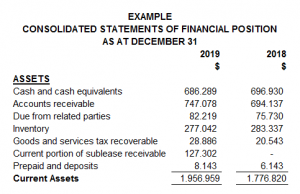
Having the financial statements in an Excel format will make it easier for the necessary calculations. Make sure you include the complete accounts next to their amounts and the two years correspondence. In the following example, we can see how it must look.
 |
Step #2
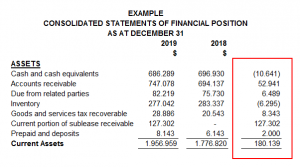
Include two columns next to the amounts inserted; the first one will be used to present the increases and decreases, and the second one will show the percentages.
The horizontal method takes each account’s value from the last year minus each account’s worth from the previous year.
For example, cash and cash equivalents from 2019 minus cash and its equivalents from 2018, as we can see as follow:
 |
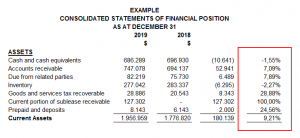
Then, the result is divided by the total of the account from the last year. In this case, the result was divided by the total cash and cash equivalent from 2019 (the most recent year), obtaining 1.55%.
 |
Step #3
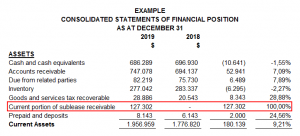
Once the percentages have been obtained, the user of the financial statements can select the account with more variation (a positive percentage if the account had an increase or a negative percentage if the account had a decrease) in the assets, liabilities, or income loss statement.
In the following example, we have the current portion of sublease receivable with 100% positive variation and cash and cash equivalents with 1.55% negative variation. The first have our special attention because it has more than 50%.
 |
Step #4
The analyst can start making questions about the variations; the first one could be which sublease did the company celebrate? In which operations or inversions the company expended cash?
You could have that information having an interview with the accounting department, the administrator, or even directly with the company’s owner, also. If the financial statement has been audited, you could read its notes.
With this method and the vertical method, it is essential to be sure about the accounts you are reviewing and investigate a lot about them. Make questions, look for supporting documents and call an expert if necessary.
Written by: Andrea Diaz
Related Articles:
Newsletters
Love Is in the Numbers ❤️ February Update from RGB Accounting
NewslettersEvents & SponsorshipArticles & Publications
Start 2026 with Confidence — RGB Accounting Expands Across Canada.
NewslettersEvents & SponsorshipArticles & Publications
Closing the Year with Purpose: RGB’s 2025 Journey
NewslettersEvents & SponsorshipArticles & Publications
Growth with Purpose — Remembering Our Roots, Reaching New Markets
NewslettersEvents & SponsorshipArticles & Publications
October at RGB Accounting: Gratitude, Growth & Smart Financial Moves 🍁
NewslettersEvents & SponsorshipArticles & Publications
Events & Sponsorship
Toronto Entrepreneurs Conference @ Mississauga
May 08, 2019 Our B.E.S.T. (Business Entrepreneurs Services Team) Group has participated in this event for first time. Toronto Entrepreneurs Conference and Trade Show is the largest Entrepreneurs event in Canada. The event which targets business owners, partners or...
Hispanic Fiesta 2018
September 04, 2018 RGB Accounting will participate in this event for a second year in a row. Hispanic Fiesta will be held at Mel Lastman Square in Toronto during the Labour Day Weekend, August 31st, Sept. 1, 2, & 3, 2018. Hispanic Fiesta is a four-day celebration...
Secure Your Future Seminar 2018
June 20, 2018 This event gathered business owners running a small or medium-sized business, self-employed and incorporated businesses willing to learn tax saving strategies to help them utilize their company assets to secure their retirement. We are proud of having...
2nd Latino Business Expo Show
May 19, 2018 The 2nd Latino Business Expo Show held on May 19th at Daniels Spectrum gathered a wide range of entrepreneurs and business owners avid to learn how to take their businesses to the next level. RGB Accounting participated as vendor and speaker at this...
Hispanic Fiesta 2017
September 04, 2017 Hispanic Fiesta, a celebration of Spanish and Latin-American: Arts, Food, Music and Entertainment, is a four-day celebration filled with the splendid sounds, tempting treats and colorful culture featuring 300 local, national and International...
Articles & Publications
Advanced Canada Workers Benefit 2026
Advanced Canada Workers Benefit 2026: Payment Dates, Eligibility and Filing Rules For Canadians who work but earn a modest income, the Canada Workers Benefit (CWB) can provide meaningful tax relief. The Advanced Canada Workers Benefit (ACWB) makes part of that support...
Canada Child Benefit 2026: New Amounts, Payment Dates and Rules Families Need to Know
Canada Child Benefit 2026: New Amounts, Payment Dates and Rules Families Need to Know The Canada Child Benefit (CCB) remains one of Canada’s most important supports for families with children under 18. Beginning with the July 2026 payment, eligible families may...
Ontario Trillium Benefit 2026: Why Updating Your CRA Information Matters
Ontario Trillium Benefit Payment on July 10, 2026: Why Keeping Your CRA Information Updated Matters For millions of Ontario residents, July marks the beginning of a new Ontario Trillium Benefit (OTB) payment year, with the first payment scheduled for July 10, 2026....
Canada Groceries and Essentials Benefit: Why Filing Your Taxes Matters More Than Ever in 2026
Canada Groceries and Essentials Benefit: Why Filing Your Taxes Matters More Than Ever in 2026 Beginning in July 2026, Canadians will start receiving payments under a newly enhanced federal benefit: the Canada Groceries and Essentials Benefit (CGEB). This new benefit...
CRA Interest Rates Remain at 7%: Why Late Tax Payments Can Cost More Than You Think in 2026
H1: CRA Interest Rates Remain at 7% for Q3 2026: Why Late Tax Payments Can Cost More Than You Think As of July 1, 2026, the Canada Revenue Agency (CRA) continues to apply an annual interest rate of 7% on overdue taxes, Canada Pension Plan (CPP) contributions, and...