
Canada’s 2026 Federal Budget: What Could Change for Your Taxes in Canada
By Roberto Belingueres, RGB Accounting
At a Glance
- The 2026 federal budget was presented on November 5, 2026. Its measures are proposals, not yet law.
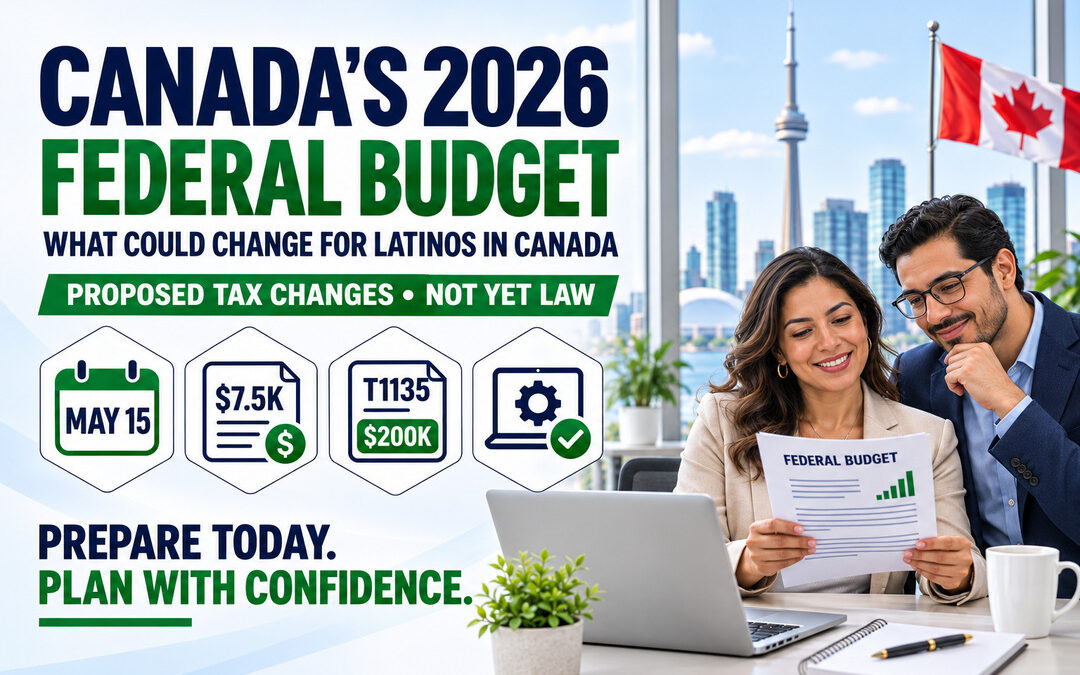
- A single May 15 deadline is proposed for filing an individual tax return and paying the balance, including for self-employed individuals, beginning with the 2027 tax year.
- Fewer tax instalment payments could be required starting in 2028: the threshold would rise from $3,000 to $7,500.
- The threshold for filing Form T1135 (specified foreign property) would increase from $100,000 to $200,000.
- You could have more time to object to a CRA assessment: one year instead of 90 days.
- Simplification does not mean filing is optional: the CRA would also receive additional enforcement resources.
What Is the 2026 Budget, and Why Does It Matter to You?
The Government of Canada presented its federal Budget on November 5, 2026, titled “Masters of our destiny.” Part of the Budget focuses on simplifying the tax system. For people who recently arrived in Canada, own a business, or hold assets in their country of origin, these changes could mean less paperwork—but also new rules worth understanding in advance.
An important clarification: these are proposals. They must be enacted into law before taking effect, and some would begin in 2027 or 2028. For the 2026 tax year, filed in 2027, the current rules still apply.
1. One Deadline: May 15
Currently, most individuals must file and pay by April 30. Self-employed individuals have until June 15 to file, although any balance owing is still due April 30. The Budget proposes making May 15 the single deadline to file a T1 return and pay the amount owing, including for self-employed individuals.
The measure would begin with the 2027 tax year, meaning the return filed in 2028. The government says that having more time to receive tax slips would help avoid reassessments.
2. Fewer Tax Instalment Payments
Tax instalments may be required when you earn income with no tax withheld, such as business income, rent, interest, or dividends. The Budget proposes raising the threshold from $3,000 to $7,500 and indexing it to inflation, beginning with tax years starting in 2028. For Québec residents, the federal threshold would increase from $1,800 to $4,500.
For people whose primary source of income is a business (including professional income and commissions), the Budget also proposes one annual instalment: two-thirds of net tax paid by December 31, with the remainder due on the following year’s balance-due date. The government estimates that approximately 1.1 million individuals and 185,000 incorporated small businesses would no longer need to make instalment payments.
3. T1135: A Higher Threshold for Foreign Property
If you are a Canadian resident and the total cost of your specified foreign property exceeded $100,000 at any time during the year, you currently have to file Form T1135. The Budget proposes increasing that threshold to $200,000. The simplified reporting threshold would increase from less than $250,000 to less than $500,000. The changes would apply to tax years ending after 2026. The estimate is that about one-third of those currently required to file would no longer have to.
A higher threshold does not mean the CRA will stop monitoring foreign assets. Canada participates in the Common Reporting Standard, which provides for automatic exchanges of financial account information among more than 120 jurisdictions, and the Budget announces a consultation to strengthen implementation. It also proposes $182.4 million over four years for the CRA to investigate tax evasion. If you hold property, accounts, or investments abroad, review your circumstances with an accountant before deciding what to report.
4. More Time to Object to an Assessment
Currently, you generally have 90 days to file an objection to a CRA assessment. The proposal would give most taxpayers one year from the assessment notice and eliminate the need to request an extension. Individuals would have until the later of that deadline and two years after their return’s filing due date.
5. Optional Flat Amounts
Starting in 2027, the Budget proposes allowing certain expenses to be claimed using an optional flat amount without retaining every receipt. One example is a $1,000 amount for work- or study-related moving expenses. Other flat amounts are proposed for medical and home accessibility credits.
6. Business Owners: Immediate Deductions for Investment
The Budget introduces the Productivity Mega Deduction, which would allow businesses to immediately deduct the cost of most new investments rather than depreciating them over several years. It would apply to investments acquired from September 15, 2026, and would be permanent. It would cover roughly two-thirds of capital assets, compared with around 15% previously. Certain assets would be excluded, including long-lived assets or those used primarily for personal purposes. If you plan to buy equipment, technology, or tools, speak with your accountant before purchasing to plan the timing carefully.
7. Benefits for Families and Workers
The Budget proposes increasing the Canada Groceries and Essentials Benefit by 50%: a family of four could receive up to $2,570 in one year. It also proposes strengthening the Build Canada Workers Benefit (up to $1,859 for an individual and $3,143 for a family) and making the Canada Caregiver Credit refundable (up to $1,260). These benefits are connected to the tax system, and the government aims to reach more people through pre-filled tax returns and broader outreach. Eligibility depends on your personal situation; review it with an accountant.
8. If You Are New to Canada
The 2027–2029 Immigration Levels Plan sets 380,000 permanent resident admissions per year, and the Budget proposes opportunities for up to 200,000 temporary residents already in Canada to transition to permanent residency before the end of 2027. If this applies to you, your first T1 return and tax history matter: they start with your first year in Canada.
What Does NOT Change: Simplification Does Not Mean You Can Stop Filing
Simplification comes alongside increased enforcement. The Budget proposes $116.5 million for the CRA to increase compliance efforts targeting non-filers and to better validate corporate tax returns before issuing refunds. The best response remains the same: file on time and keep your documents organized.
Frequently Asked Questions
Has the Tax Filing Deadline in Canada Already Changed?
No. The current deadlines still apply to the 2026 tax year. May 15 is a proposal for the 2027 tax year onward.
What Is Form T1135?
It is the form used to report specified foreign property—such as certain accounts or investments outside Canada—when its cost exceeds the applicable threshold. The Budget proposes raising that threshold from $100,000 to $200,000.
If I Own Assets in My Home Country, Do I No Longer Have to Report Them?
Not necessarily. Form T1135 is only one part of your obligations: Canadian residents report worldwide income, and the CRA participates in international financial information exchanges. Review your circumstances with an accountant.
Would These Changes Apply in Québec?
The Budget is federal. Québec has a separate provincial return filed with Revenu Québec, and its deadlines and rules must be confirmed separately.
What Should I Do Now?
Gather your tax slips and supporting documents, note any assets held abroad and any income without tax withholding, and schedule a consultation before tax season.
Book a Consultation with RGB Accounting
We are accountants who speak your language and serve clients across Canada. Call us: Toronto (416) 932-1915 · Ottawa (343) 882-4900 · Calgary (587) 487-7001 · Vancouver (778) 381-1040.
This article is for general information only and is not personalized tax advice. The measures in Budget 2026 are proposals subject to legislative approval—source: Government of Canada, Budget 2026 (budget.canada.ca).
Newsletters
No Results Found
The page you requested could not be found. Try refining your search, or use the navigation above to locate the post.
Events & Sponsorship
Talent Kids Event 2017
August 19, 2017 RGB Accounting has proudly sponsored the 2017 Talent Kids event organized by Pecora Events on August 19th. RGB Accounting wants to thank organizers, presenters, judges, and all participants for making this a great event. Here we share some of the...
Los Nocheros USA/Canada Tour 2017
June 02, 2017 Argentina's biggest folkloric phenomenon arrived in Toronto, Canada to celebrate its 30 years trajectory. RGB Accounting was one of the sponsors of the event. More from our blog Newsletters Events & Sponsorship Articles &...
2nd Latin American Entrepreneur Conference
May 29, 2017 The Entrepreneur Conference was organized by the City of Toronto's Economic Development & Culture department in partnership with the Latin American Bi-Lateral Trade Initiative (LABTI) which consists of the Consulate Generals of Argentina, Brazil,...
Tax Season 2017 at La Liga Indoor Soccer
April 29, 2017 RGB Accounting has been sponsoring social events to promote cultural values in the hispanic community of Toronto and the GTA. The During the last tax season, RGB Accounting helped many individuals and small business owners to prepare their taxes,...
Articles & Publications
Buying a Business in Canada: Seven financial tests for resilient growth
Buying a business in Canada: Seven financial tests for resilient growth This article is for you if you are a business entity operating in Canada. Before buying a business in Canada, a buyer should test strategic fit, whether earnings convert to cash, working-capital...
U.S. Brokerage Account: I Never Withdrew the Money… So Why Would I Owe Tax?
U.S. Brokerage Account: I Never Withdrew the Money… So Why Would I Owe Tax? Understanding realized and unrealized gains on foreign investment accounts By Roberto Belingueres, Founder & CEO, RGB Accounting | 7-minute read As more Canadians invest internationally...
Foreign Investments, U.S. Brokerage Accounts, and Canadian Taxes: The 10 Most Common Mistakes We See
Foreign Investments, U.S. Brokerage Accounts, and Canadian Taxes: The 10 Most Common Mistakes We See By Roberto Belingueres, Founder & CEO, RGB Accounting Estimated reading time: 10-minute read A practical cross-border tax guide for Canadian residents, business...
Advanced Canada Workers Benefit 2026
Advanced Canada Workers Benefit 2026: Payment Dates, Eligibility and Filing Rules For Canadians who work but earn a modest income, the Canada Workers Benefit (CWB) can provide meaningful tax relief. The Advanced Canada Workers Benefit (ACWB) makes part of that support...
Canada Child Benefit 2026: New Amounts, Payment Dates and Rules Families Need to Know
Canada Child Benefit 2026: New Amounts, Payment Dates and Rules Families Need to Know The Canada Child Benefit (CCB) remains one of Canada’s most important supports for families with children under 18. Beginning with the July 2026 payment, eligible families may...